A plain-English guide to systematic trading and how to copy it on eToro (Canada edition)
Canada · eToro CopyTrader · 2026
01
How I got here
I was a construction manager. Good money, genuinely skilled at the work, but the environment was grinding me down in ways I did not have words for at the time.
So I started learning to code. That led me to RefugeesCode, a not-for-profit that taught coding to newcomers. I ended up becoming its director, which taught me more about building systems from scratch than any other role I had held: how to hold a vision under pressure, how to debug when nothing is working, how to actually finish something. I came out of that phase with a different relationship to complexity. I stopped finding it intimidating and started finding it interesting.
Conventional investing was something I tried alongside all of that. It was a disaster. Not because I lacked information; I had plenty. The problem was that I could not stay calm when things went sideways. My emotions kept overriding my logic. I would read a headline and react. I would see a loss and panic. I would see a gain and get greedy. Classic. Embarrassingly classic.
Then I found Mandelbrot's book, The (Mis)Behaviour of Markets. That was the crack in the door. The idea that markets have a measurable shape, that they follow fractal patterns, that they are not purely random noise and not purely predictable either. I spent years alongside that reading studying the work of Trader Daye and ICT, learning to read market structure at a level most retail traders never reach.
At some point these threads started connecting in my head. What if I could build a system that measured the fractal state of the market and then executed trades based on rules I had written in advance, not feelings I was having in the moment? I started running backtests. The results blew me away. Two months of focused coding later, I had something real.
About a month ago, I stepped back and looked at what I had actually built: five strategies running simultaneously, each one exploiting a different feature of market structure, with combined backtested performance above hedge fund level. I will not pretend that did not feel like a significant turning point.
One honest note before anything else. The system is currently in paper trading: it runs on live market data, on a dedicated server, 24 hours a day, but against a practice account rather than real capital. Everything you read about performance in this document is backtested, meaning it was computed by replaying the strategy rules against historical price data rather than from real trades with real money. I will flag this clearly every time it matters. The paper trading phase exists so that when real money eventually enters the picture, I can point to a clean live record and say: it behaved exactly as the backtest predicted.
02
Why most trading advice fails you
The problem is not information. Canadians who want to invest are not short of advice. The problem is that most advice assumes you will behave rationally when money is on the line. You will not. Almost nobody does.
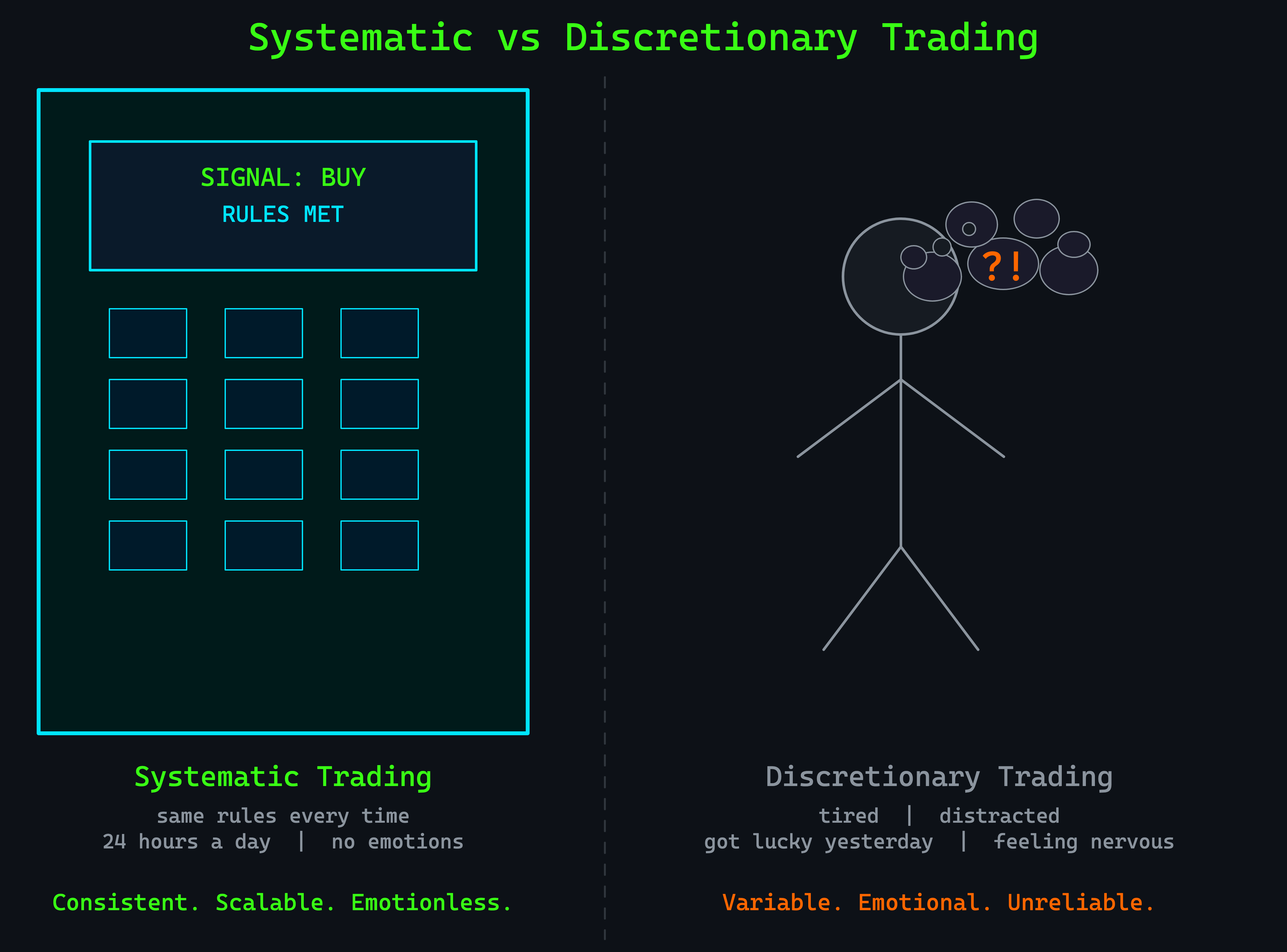
Think about two ways to sell food. A shopkeeper makes a judgment call on every transaction: how fresh does this look, is this customer a regular, should I offer a discount today? The shopkeeper has context, intuition, and years of experience, but the shopkeeper also gets tired, distracted, and emotional. A vending machine executes the same logic every time, at any hour, without caring what the market did this morning. It does not panic. It does not second-guess. It does not read the news.
Systematic trading executes identical logic every time. Discretionary trading makes a new judgment call every time.
Traditional investors are shopkeepers. They mean well. They research. They have strong opinions. And then a market crash happens, or a media frenzy, or a friend's hot tip, and all that research gets overridden by something older and faster: fear, greed, social pressure.
The system I built is a vending machine. Every decision is encoded in rules written before any trade happens. The software reads the data, checks the rules, and either takes the trade or it does not. No human judgment at the moment of execution. No override for emotion. No "but what if this time is different."
Yes, I know the obvious objection: vending machines are also the things that eat your dollar and keep the chocolate bar. Fair enough. The difference is that this one is monitored around the clock and wrapped in the safety layers I get to in section six. What matters here is the principle, not the hardware: identical logic, every time, with no mood swings.
This is not about being smarter than other traders. It is about removing the single biggest failure mode in retail investing: yourself, in a moment of stress.
03
Markets have a shape. I measure it.
Here is the idea that changed everything for me. Markets are not random noise, but they are also not simply predictable. They have a structure, a shape, and that shape is measurable.
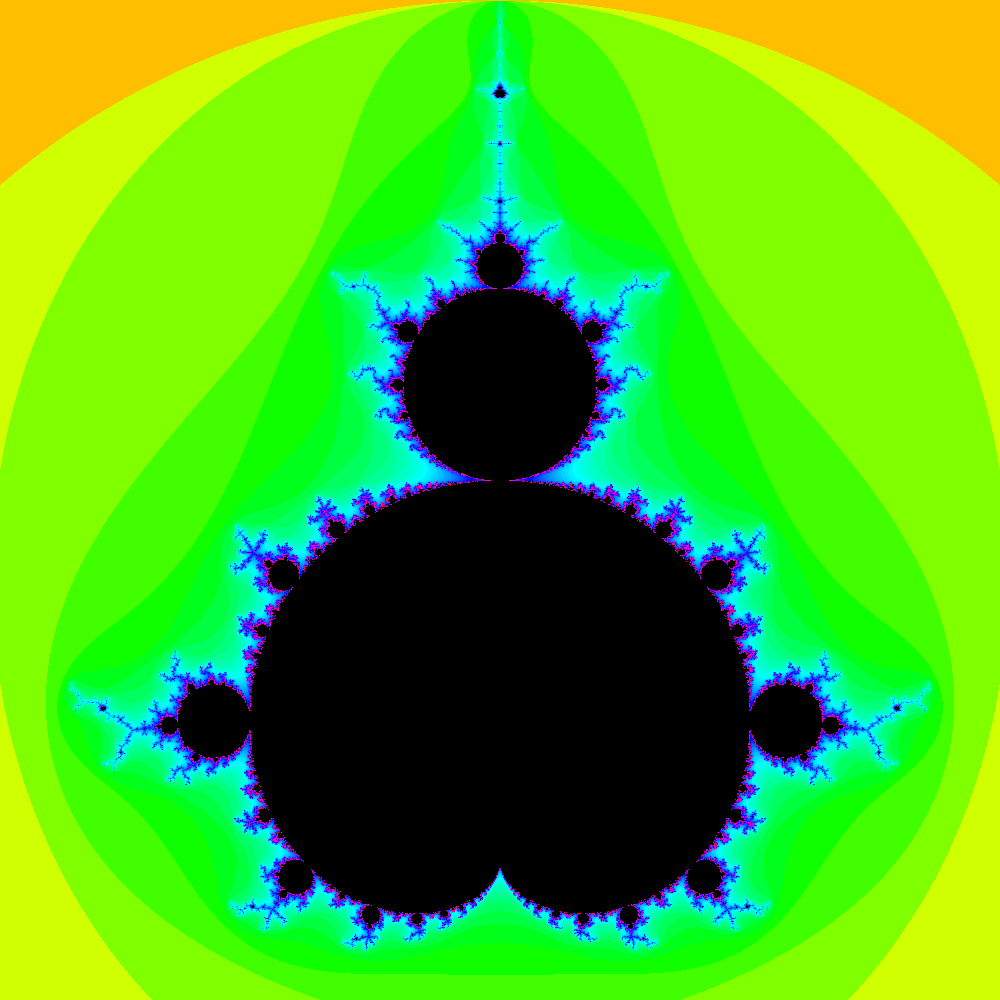
The technical term is a fractal. A fractal is a pattern that repeats itself at different scales: zoom in on a coastline and you see the same jagged irregularity you saw from the satellite image. Markets behave similarly. The structure of price movement on a small timeframe echoes the structure on a larger timeframe. Mandelbrot noticed this decades ago. I built tools to measure it.
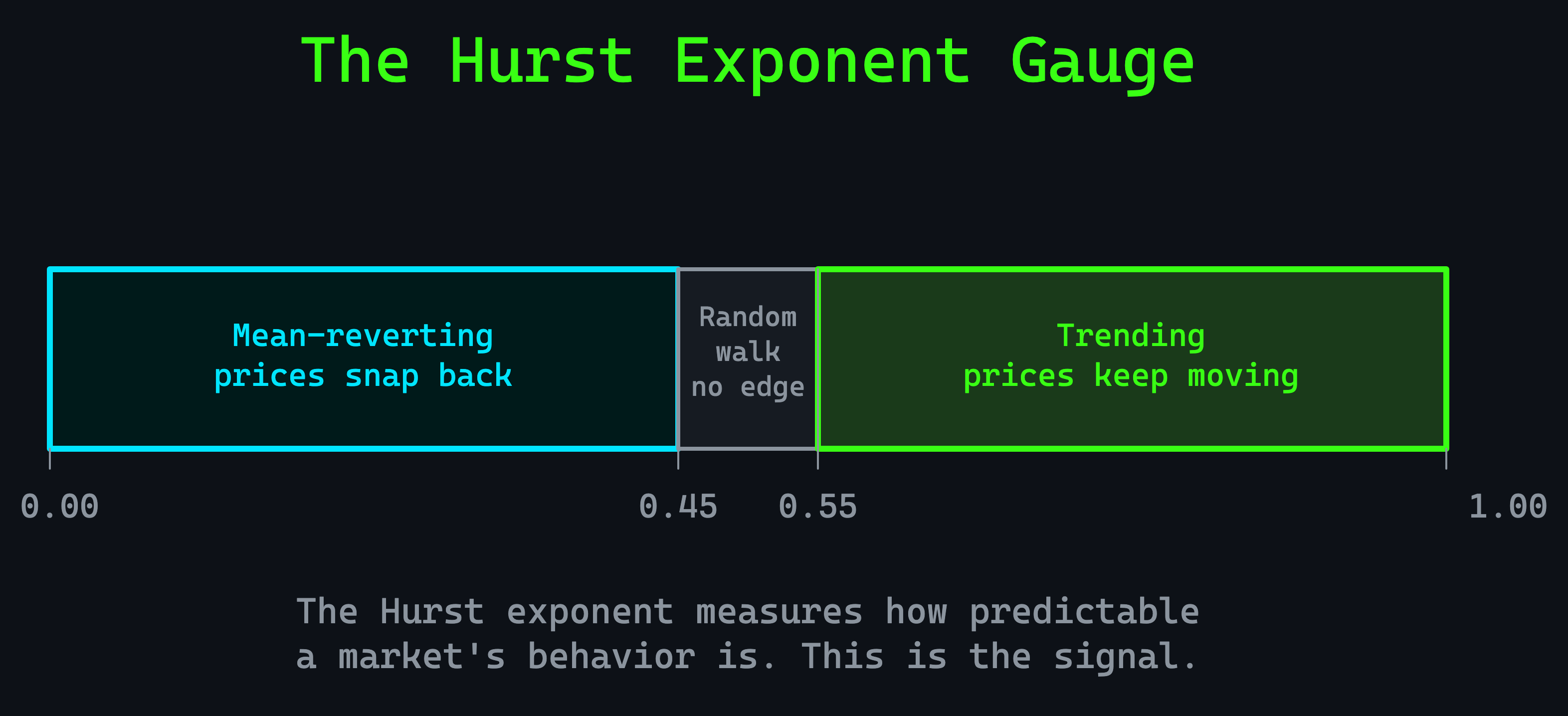
The key measurement is called the Hurst exponent: a number between 0 and 1 that tells you whether the market is currently trending or bouncing. Plain English: a Hurst reading above 0.5 means the market has momentum, prices are moving in a direction and tend to keep moving that direction. A reading below 0.5 means the market is mean-reverting, prices have swung too far and tend to snap back toward centre. Right at 0.5 means pure randomness, no edge in either direction.
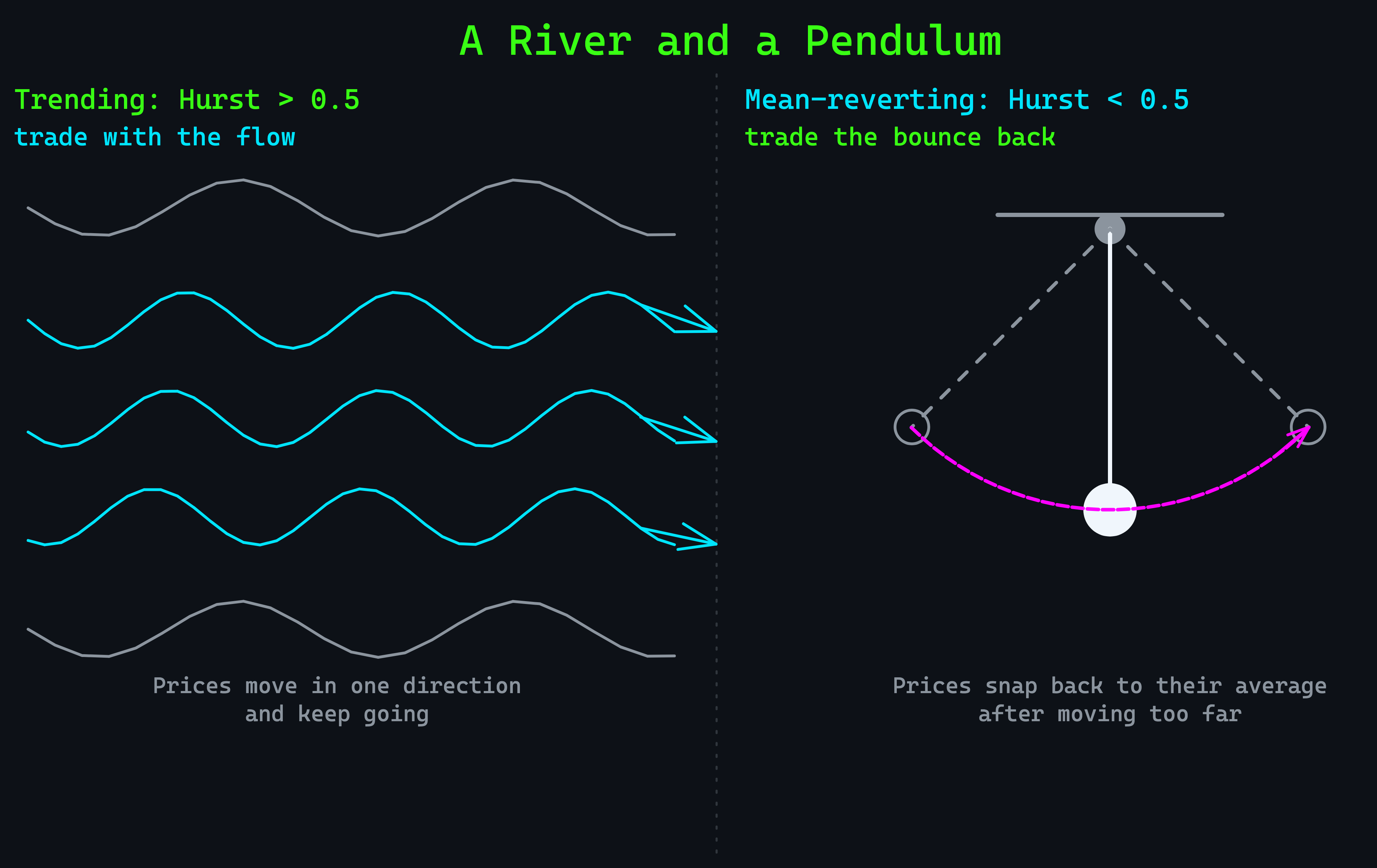
Here is a better way to picture it. Imagine a river and a pendulum.
When a market is trending, it flows like a river: steady direction, momentum building. When mean-reverting, it swings like a pendulum: overshooting, then correcting back toward centre.
Sometimes the river flows steadily downstream. If you jump in, you go downstream. That is a trending market: momentum carries you. Sometimes the river is more like a pendulum, swinging side to side around a centre point. Jump in then, and the pull is toward the middle, not one end. That is a mean-reverting market: extremes correct back toward average.
The error most traders make is treating every market like it is always flowing in one direction. Some strategies work in trending conditions. Others work in mean-reverting conditions. Mine measure which state is active right now and trade accordingly.
The Hurst exponent reading, tracked over time, tells the system which regime is active. The strategy adapts automatically: trend-following when the market is flowing, mean-reversion when it is oscillating.
For the technical reader: The Hurst exponent is computed over a rolling window of recent price history using rescaled range (R/S) analysis, the method developed by H.E. Hurst and extended by Mandelbrot. The result is a real number between 0 and 1: above 0.5 indicates persistence (trending), below 0.5 indicates anti-persistence (mean-reverting). Parameter thresholds and window lengths were determined through a walk-forward bake-off across 6 independent time folds, with an explicit penalty for parameter fragility: settings that only work at one precise value are rejected even if that value looks excellent in isolation.
04
The five strategies
I run five strategies simultaneously. They are designed to be uncorrelated: each one looks for a different type of market condition, so they do not all win and lose at the same moment. Four of the five are available on eToro. The fifth runs on a different brokerage and is not part of the copy offer.
Each strategy risks exactly 1% of your copy allocation per trade. On a $10,000 copy, that is $100 per trade. On a $5,000 copy, that is $50 per trade. The percentage does not change regardless of market conditions or recent performance.
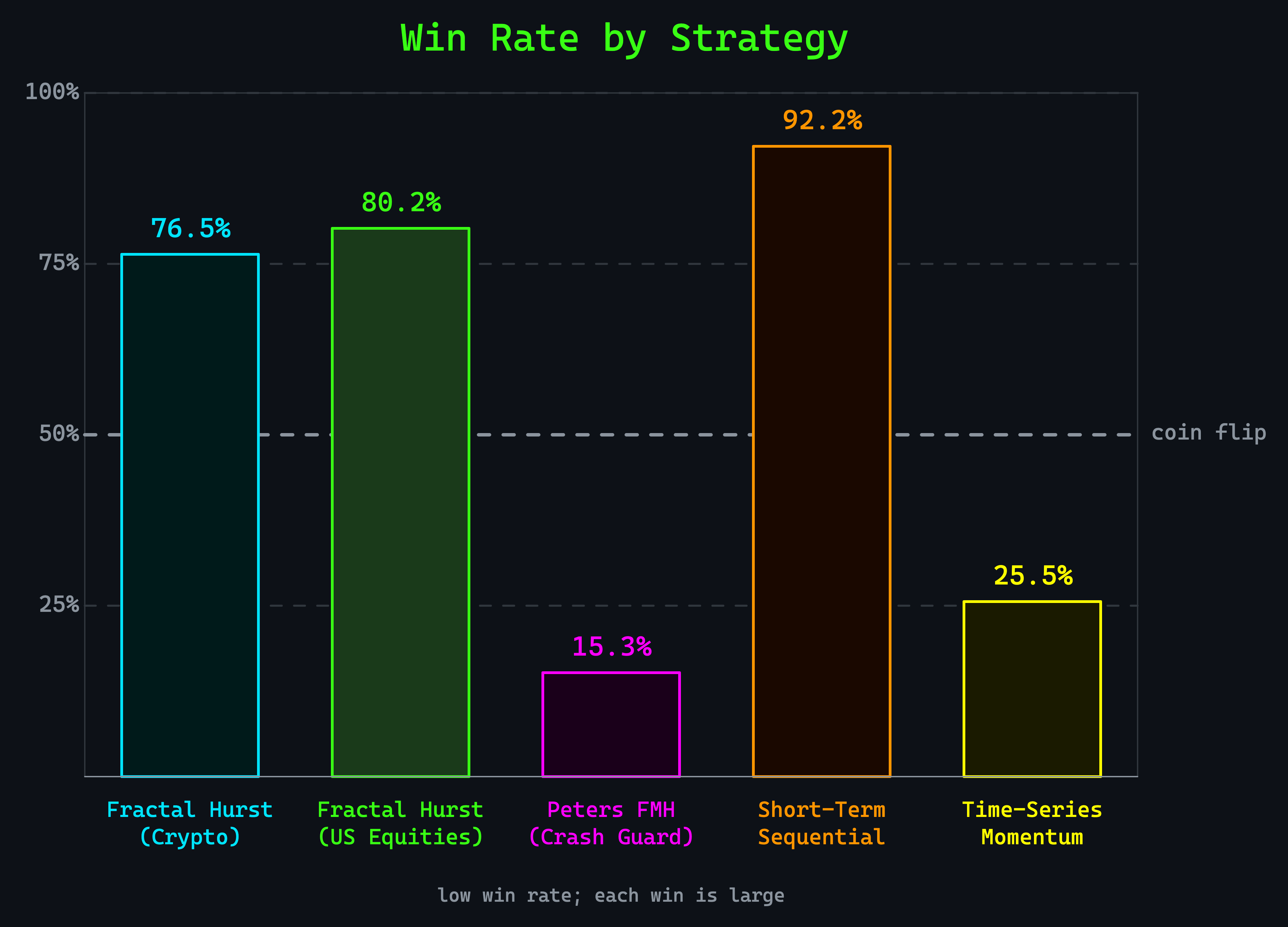
Win rate tells you how often a strategy is right: the share of its trades that ended in profit. It does not tell you how much it makes when it is right versus how little it loses when it is wrong. A strategy can win rarely and still be highly profitable if its wins are large enough, which is exactly what you will see with one of these.
Win rates vary significantly by design. A high win rate does not automatically mean high profit: what matters is the relationship between win size and loss size, measured in R multiples (explained below).
On eToro
Fractal Hurst: Crypto
Bitcoin + Ethereum
I measure Bitcoin and Ethereum's fractal rhythm. When the Hurst signal says crypto is in a trending phase, I trade with the trend. When it says prices have stretched too far and are likely to snap back, I trade the reversion. The same mathematical framework applied to the most volatile instruments in the portfolio.
Win rate76.5%
6-year profit on $10k copy+$10,500
Worst drawdown-1.4% of copy
All 6 time periodsPositive
On eToro
Fractal Hurst: US Equities
S&P 500 + Nasdaq + Dow Jones
The same Hurst regime-detection applied to US equity indices. When the market is in a strong trending phase, I trade that trend. When indices have run too far and the fractal structure says they are likely to revert, I trade the correction. This strategy accounts for the largest share of overall trades in the portfolio and has the highest cumulative profit of the two Hurst strategies.
Win rate80.2%
6-year profit on $10k copy+$15,600
Worst drawdown-9% of copy
All 6 time periodsPositive
On eToro
Peters FMH: Crash Guard
S&P 500 + Nasdaq + Dow Jones
This one works differently. It is based on Edgar Peters' 1994 Fractal Market Hypothesis: the idea that markets become fragile when short-term traders dominate and longer-horizon investors step back. When short-term thinking takes over, the market loses its normal shock-absorption and sharp moves become likely. This strategy detects those fragile conditions and positions for the resolution, which often happens fast. It wins only 15.3% of the time. That sounds terrible until you understand the structure: most losing trades exit close to breakeven rather than at a full loss, while the occasional win is very large. A losing trade is capped at 1% of copy by a protective stop, which was rarely triggered across the backtest. Think of it as insurance that pays out spectacularly when markets get chaotic. Across 6.3 years of backtesting its worst dip was about a tenth of one percent, the smallest of any strategy here; but that reflects a period in which the protective stop was seldom hit. A sharp adverse move can trigger it and produce real losses, so this is not a guarantee of near-zero drawdown.
Win rate15.3%
6-year profit on $10k copy+$24,100
Worst drawdown-0.1% of copy
All 6 time periodsPositive
On eToro
Time-Series Momentum
S&P 500 + Nasdaq + Dow Jones
One of the most well-documented phenomena in academic finance: assets that have been rising tend to keep rising for a period; assets that have been falling tend to keep falling. I ride the wave and exit when momentum reverses. This strategy wins only 25.5% of the time, meaning it loses more trades than it wins. That is intentional: losses are small (cut quickly at 1% of copy), and wins are large (held as long as momentum persists). It can have quiet stretches of several months. It is never run alone; it is always part of the combined portfolio, where the other three strategies have historically offset its quiet periods with their own gains.
Win rate25.5%
6-year profit on $10k copy+$2,500
Worst drawdown-4% of copy
All 6 time periodsPositive
Not on eToro
Short-Term Sequential
EUR/USD + GBP/USD + CHF/USD
This strategy runs on a separate brokerage and is not part of the eToro copy offer. It looks for consensus across major FX pairs: all three pointing the same direction at the same moment on the same timeframe. The logic is that agreement across related markets is a stronger signal than any one market alone. It carries a 92.2% win rate across its 6-year backtest. It is not on eToro because the strategy's entry timing requirements are better served by a different brokerage infrastructure. It is included here for completeness.
Win rate92.2%
PlatformOANDA only (not eToro)
All 6 time periodsPositive
The per-strategy figures above are flat (non-compounding) contributions at 1% risk per trade ($100 on a $10,000 copy), already discounted 1.5x for selection bias. Run together and compounded as gains are reinvested, the portfolio reaches the figure shown below. If you copy with $5,000 the dollar figures halve; win rates and the underlying edge are identical regardless of copy size. All figures are backtested, not a live track record.
05
Does it actually work?
Numbers first, then context. But before either: a quick translation guide, because trading performance gets measured differently from most investments.
A brief word on R multiples
Throughout this document I measure strategy performance in R multiples, where R is one unit of risk. If a trade risks $100 on a $10,000 copy and the trade wins $200, that is +2R. If it loses, it loses exactly $100: that is always -1R. Using R lets me evaluate a strategy's skill independently of capital size; then you multiply by your own per-trade risk to find the dollar outcome that applies to you.
The combined eToro portfolio produced 791R over 6.3 years. At 1% risk per trade ($100 on a $10,000 copy), discounted 1.5x for selection bias and compounded as gains are reinvested (the way copy trading works), the backtested account reaches approximately $261,574, roughly 1.5x what Ethereum buy-and-hold returned over the same window.
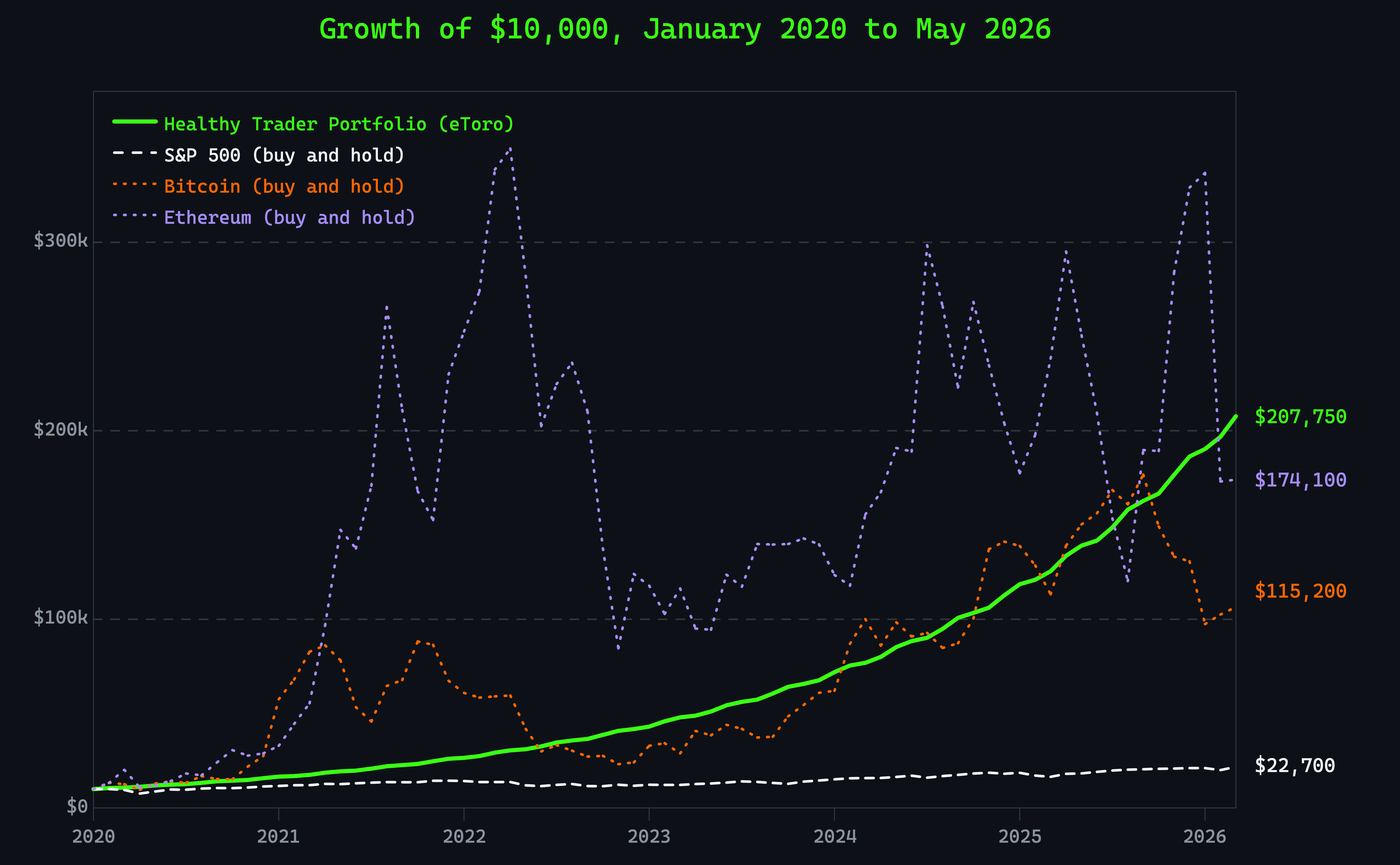
Here is what $10,000 grew to over the same six-year window; the Healthy Trader portfolio against simply holding an index or crypto:
Starting value $10,000, January 2020 to May 2026. Healthy Trader Portfolio: backtested, 1% risk per trade, compounded and discounted 1.5x. S&P 500, Bitcoin, and Ethereum: buy-and-hold, computed from OANDA real price data. All four start from the same date and same capital.
Starting with $10,000
Ending Value
Total Growth
Worst Drawdown
Healthy Trader Portfolio 4 strategies, 1% risk per trade, backtested
$261,574
+2,516%
~5% modeled crash ~20-31%
S&P 500 buy-and-hold Hold and do nothing
$22,700
+127%
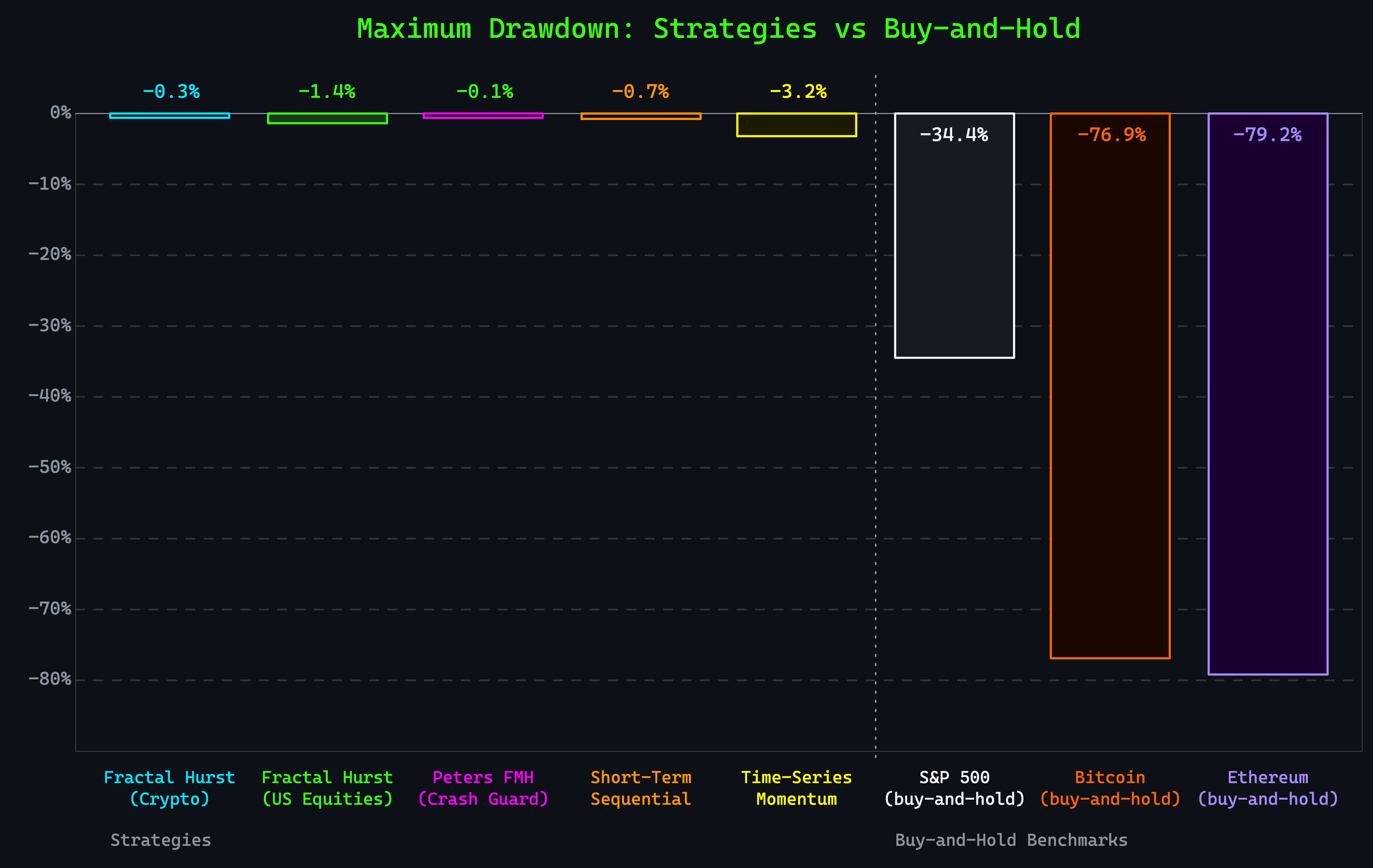
-34.4%
Bitcoin buy-and-hold Hold and do nothing
$115,200
+1,052%
-76.9%
Ethereum buy-and-hold Hold and do nothing
$174,100
+1,641%
-79.2%
All figures computed from OANDA real price data, January 2020 to May 2026. S&P 500, Bitcoin, and Ethereum represent simple buy-and-hold returns. Healthy Trader Portfolio figures are backtested results and do not represent a live trading track record.
In plain terms: the combined portfolio finished more than $87,000 ahead of Ethereum buy-and-hold, with roughly a sixteenth of Ethereum's worst drawdown. Ethereum dropped 79.2% at its worst point in this window. Many people who bought Bitcoin or Ethereum did not actually hold through those drops; the pressure to sell at the bottom was enormous. The portfolio's worst dip across the 2020 to 2026 backtest, which includes the COVID crash and the 2022 bear market, was about 5%, and every year finished positive. Over that same period the S&P 500 fell 34%. Because that stretch was unusually kind to these strategies (their protective stops rarely triggered), we also model a harsher future: if a crash hits where the strategies fall together and every stop fires, the worst drawdown would be nearer 20%, and around 30% in a severe crash. Even that modeled crash is shallower than what the S&P 500 actually went through, and not the kind of number that typically causes people to make panicked decisions.
The one thing that separates this from normal investing. Traditional investing only makes money when prices go up: you buy, you wait, you hope the line climbs. This is different. The system can take both "long" positions (which profit when a price rises) and "short" positions (which profit when a price falls), and it adapts to whichever way the market is actually moving. A falling market is not a disaster to sit through; it is simply another condition to trade. That is why these strategies stayed positive straight through the 2020 COVID crash and the 2022 downturn, while buy-and-hold investors were deep underwater.
A quick word on drawdown, since it matters here. A drawdown is the biggest drop from a peak before the value recovers: the worst temporary loss you would have had to sit through on screen. Lower is calmer. Here is the worst peak-to-trough drop each one suffered along the way:
How far each investment fell from its peak at any given point. Smaller drawdowns mean a smoother ride and less psychological pressure to sell at exactly the wrong moment.
What this backtesting window actually covers. January 2020 to May 2026 includes six meaningfully different market conditions: the COVID crash and recovery in 2020, the 2021 bull run across equities and crypto, the 2022 rate-hike bear market, the 2022-2023 crypto winter, the 2023-2024 recovery, and the 2025-2026 period. The combined portfolio was positive in every one of those regimes. That matters more to me than the headline return figure, because it suggests the strategies were not just optimised for one type of market.
06
Is this safe? The six risk layers.
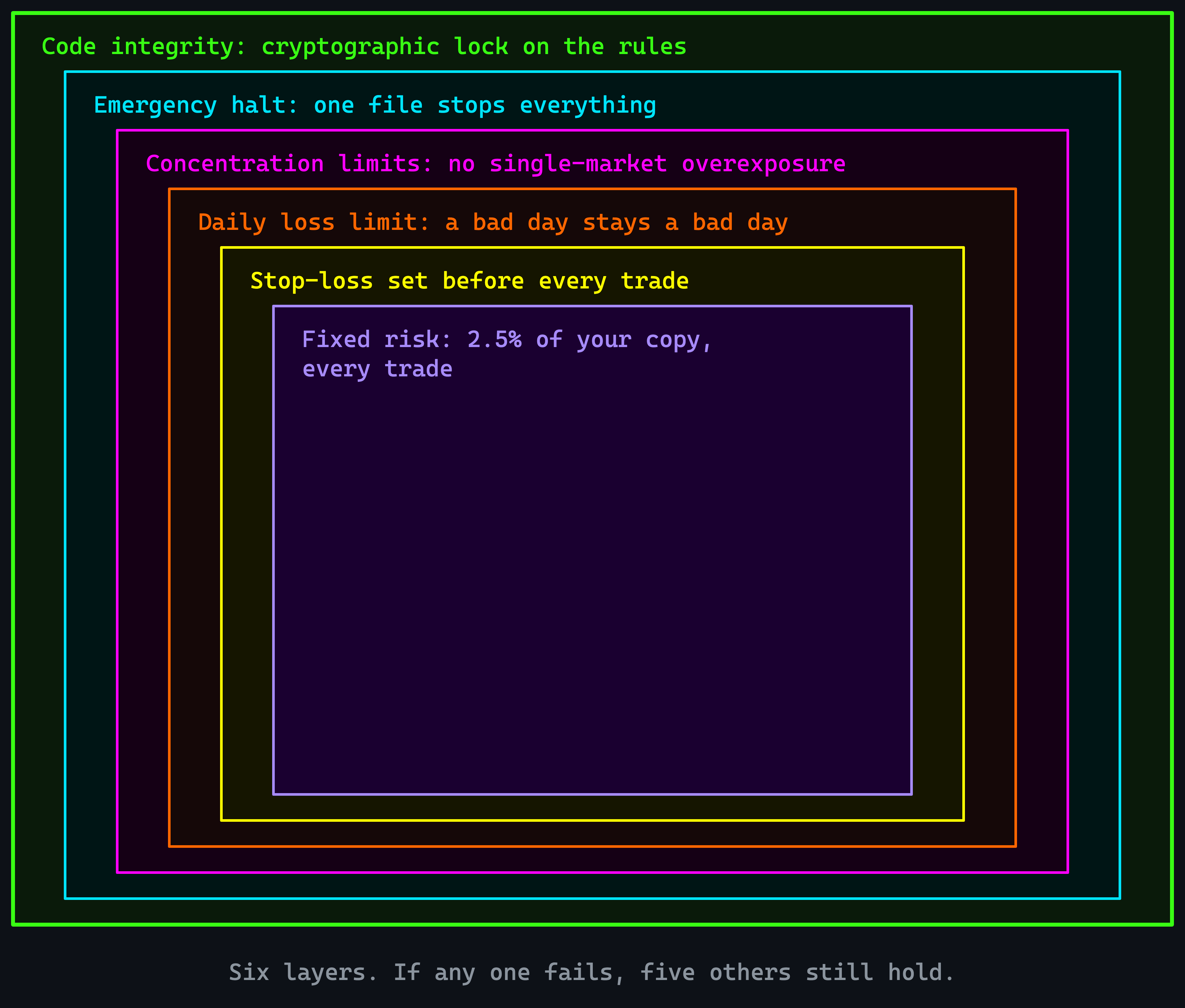
Risk is not managed by hoping; it is enforced mechanically by the software. There are six independent layers, and failure of any one layer does not disable the others.
Each layer operates independently. The system does not rely on any single mechanism to prevent a loss from becoming a catastrophic one.
1
Fixed risk per trade
Every trade risks exactly 1% of the copy allocation, no matter what. On a $10,000 copy, that is $100. The system cannot increase this after a winning streak (which is exactly when overconfident traders get hurt) or decrease it after a losing stretch (which is exactly when fearful traders miss recoveries). The percentage is set in code. It does not drift.
2
Stop-loss on every trade
Every trade has a pre-defined exit level, called a stop-loss: an instruction set in advance that automatically closes the trade if the price moves against it by a set amount, calculated from market volatility at the moment the trade is placed. If that level is hit, the position closes on its own. No human needs to act. No override is possible. The maximum loss on any single trade is capped before the trade ever opens.
3
Daily loss limit
If the total loss across all strategies on a given day reaches a threshold (approximately 3 to 5 times the per-trade risk, so $750 to $1,250 on a $10,000 copy), the system stops entering new trades for the rest of that day. A bad day cannot become a catastrophic day.
4
Concentration limits
No more than 15 trades open at any time. No more than 2 trades in the same instrument at once. Margin (the broker's collateral requirement) capped at 30% of the account value. These rules prevent the portfolio from being overexposed to any single market event, regardless of how many signals appear simultaneously.
5
Emergency halt switch
A single command on the server stops all new trade entries across all strategies instantly. Existing trades continue to be managed normally (stops and exits still function). This can be triggered from any device in seconds. I have not needed to use it; it is there nonetheless.
6
Code integrity verification
Before each trading session, the software verifies that the live code matches a cryptographically signed snapshot taken at the time of strategy approval. If anything modifies the trading logic without authorisation, the system refuses to start. This prevents silent code drift, one of the most common failure modes in automated trading systems, where someone makes a small "improvement" to the code and inadvertently changes the strategy's behaviour in production.
07
How copying me works
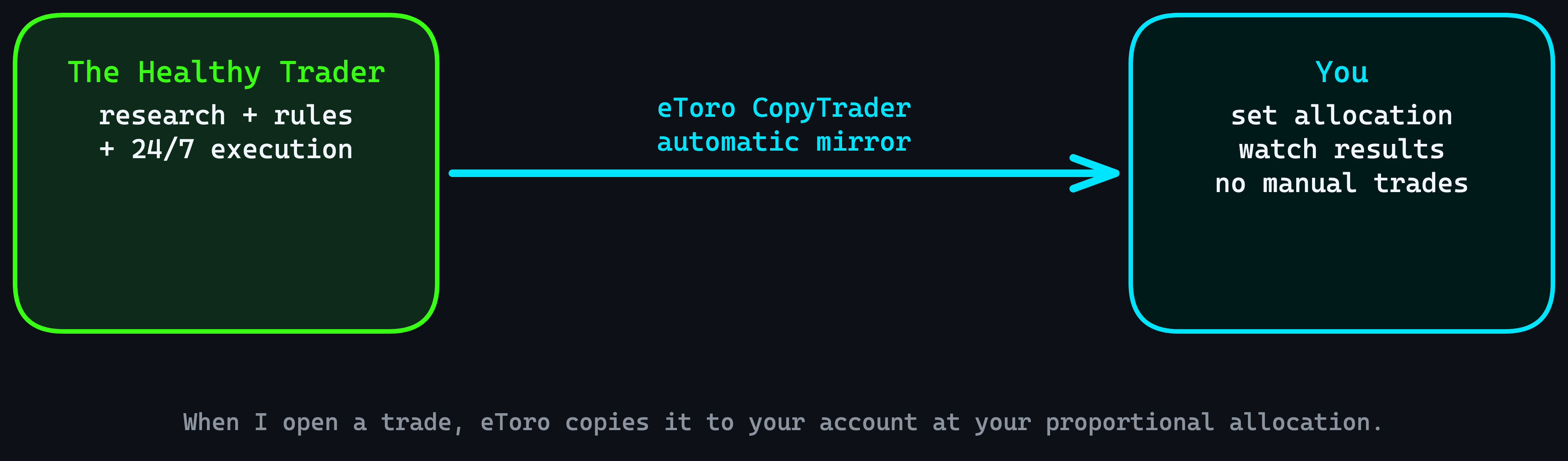
eToro's CopyTrader is a mechanism for mirroring another trader's positions automatically. When I open a trade, your copy account opens the same trade, scaled to your allocation. When I close it, yours closes too. You do not need to do anything after the initial setup.
When a strategy opens a trade, your copy account mirrors it automatically, scaled to your copy amount. The mechanism is managed by eToro's platform infrastructure.
Think of it as an autopilot. The rules are set, the system executes, and you can check in whenever you like, but you do not need to be watching. You can pause or stop copying at any time with no penalties from the copying mechanism itself. (eToro may have requirements around managing open positions when you stop; check their current terms.)
Here is what you control:
The copy amount (only invest what you can genuinely afford to lose)
When you start copying
When you stop or pause copying
Here is what you do not control:
Which instruments are traded (determined by the strategies)
Entry and exit timing (determined by the algorithm)
Position sizing (set at 1% per trade by the system, scaled to your copy amount)
Paper trading status. As of May 2026, the system is in the paper trading validation phase, running on practice accounts. The eToro CopyTrader offer will go live after that phase is complete and I can show a clean live track record. The waitlist at the end of this document is how you hear about it first. You are not handing anyone money today.
08
Getting started on eToro Canada
When the copy offer goes live, here is what signing up looks like. Verify all current eToro Canada terms, fees, and requirements at etoro.com before proceeding; platform details may change.
1
Create your eToro account
Visit etoro.com and sign up with an email address and password. The registration itself takes about five minutes.
2
Verify your identity (required by Canadian law)
As a regulated Canadian platform, eToro is required under FINTRAC rules (FINTRAC is Canada's federal financial intelligence agency, which oversees identity verification for all licensed investment accounts) to verify your identity before you can deposit or trade. You will typically need to upload a government-issued ID and a proof of address document. The process is completed online and usually takes one to two business days.
3
Fund your account
Deposit the amount you want to copy with. Only use money you can genuinely afford to lose. eToro accepts bank transfers, credit cards, and other payment methods; check current minimums and supported methods at etoro.com.
4
Find The Healthy Trader on eToro
Use the search bar to find my eToro account. The exact username will be confirmed in the waitlist email when the copy offer goes live.
5
Click "Copy" and set your amount
Set your copy amount, review the current open positions and risk settings, and confirm. From that point, your account mirrors my trades automatically.
6
Set a copy stop-loss limit (optional but recommended)
eToro lets you set a maximum loss threshold on your copy. If your copy allocation drops by that percentage, eToro automatically stops copying and returns the remaining funds to your account. This is separate from the per-trade stop-losses the system already uses; it is an extra safety net at the copy level. Setting this to a level you are comfortable with, for example 20% to 30% of your copy amount, is a sensible step before the copy goes live.
7
Check in whenever you like
You do not need to monitor daily. The system runs continuously, including when you are asleep or away. Log in to see current positions, performance history, and trade details at any time. You can stop copying at any time.
The copy offer is not live yet. Join the waitlist at hello@healthytrader.finance and I will contact you directly when it is ready, before any public announcement.
09
Frequently asked questions
Ten questions I get asked most, answered directly.
What if you have a rough patch?
Worth asking directly. Here is what the backtesting actually shows: the combined portfolio of four strategies has not had a single negative six-month period across any of the 6 testing windows, including through the 2020 COVID crash, the 2022 rate-hike bear market, and the 2022-2023 crypto winter. Individual strategies absolutely have rough stretches; Time-Series Momentum in particular can lose more trades than it wins for months at a time. But the combined effect, across the full 6.3-year backtest, has been positive in every six-month window tested. That is because the strategies are intentionally uncorrelated: when momentum is quiet, the Hurst regime strategies tend to be producing gains, and when markets become fragile and volatile, Peters FMH tends to produce its largest wins.
None of that is a guarantee of future behaviour. If there is a rough patch in live trading, you will see it in your account in real time. The rules do not change; the system does not try to make up ground by taking bigger risks.
How much money do I need to start?
eToro has its own minimum deposit requirements; check etoro.com for current figures. From a strategy perspective, any copy amount works: the system always risks 1% per trade regardless of size. On $1,000 that is $25 per trade. On $10,000 that is $100. The proportional logic is identical. What matters more than the minimum is a ceiling you set yourself: only copy with money that, if it went to zero in a worst-case scenario, would not materially affect your financial situation.
Is this regulated?
eToro Canada Ltd. is regulated in Canada and subject to applicable Canadian securities regulations. You are copying a trader on a regulated platform. I am not a registered investment adviser or portfolio manager under any Canadian provincial securities legislation or CIRO rules. This is standard for eToro's CopyTrader model: the platform is regulated; individual traders being copied are not licensed financial professionals. Check eToro's current Canadian regulatory disclosures at etoro.com, and verify registration status of any financial service through CIRO's public registry at ciro.ca.
What if I want to stop copying?
You can stop at any time from within the eToro app. When you stop copying, you will be given options about how to handle any open positions at that moment. There are no lock-up periods from the copying mechanism itself. Check eToro's current interface for the exact stop-copy flow, as platform details can change.
Are there fees?
eToro charges spreads (the difference between the buy and sell price) on trades, and may charge overnight financing fees on positions held past market close. I do not charge a separate management fee; any copy trading costs are eToro's platform fees. Check eToro's current fee schedule at etoro.com before opening an account, as fee structures can change.
Why eToro and not a Canadian bank or broker?
Canadian bank brokerages do not offer CopyTrader functionality: there is no mechanism to automatically mirror another person's trades at TD Direct Investing, RBC Direct Investing, or similar platforms. eToro was built specifically to support this. It is regulated in Canada, offers the instruments my strategies trade (US equity indices, crypto), and has a large enough user base that CopyTrader is a meaningful, supported product. I chose it for the copy mechanism, not as a general endorsement of every feature it offers.
What markets does this trade?
The eToro portfolio trades US equity indices (S&P 500, Nasdaq, Dow Jones) and cryptocurrency (Bitcoin and Ethereum). Those four strategies cover both asset classes. The fifth strategy, Short-Term Sequential, trades foreign exchange (EUR/USD, GBP/USD, CHF/USD) on a separate brokerage and is not part of the eToro copy offer. All instruments traded are liquid, regulated, and have decades of clean price history used in strategy development and validation.
When will you switch from paper trading to real money?
The system has been running live on practice accounts since May 2026, on a dedicated server, against real market data. The target is a clean four-to-eight week live paper record before committing real capital, including my own. The eToro CopyTrader offer follows after that validation phase. I am not rushing this part. The paper trading phase is how I verify that live behaviour matches backtest behaviour before any actual money is on the line.
Do I need to understand fractals to participate?
No. The fractals are what I understand and what the system measures. You need to understand three things: that you are copying a rules-based automated system, that each trade risks 1% of your copy allocation, and that past backtested results do not guarantee future performance. That is the full informed-participant checklist. You do not need to know what a Hurst exponent is any more than you need to understand aerodynamics to fly somewhere.
Could I lose my entire copy allocation?
I want to answer this accurately, not with a boilerplate disclaimer. In theory, any investment can lose its entire value. In practice, here is what it would take with this system: losing trade after trade for an extended period, at 1% per trade, with the daily loss limit never functioning to slow things down. Across the entire 6.3-year backtest, the combined portfolio's worst period across the full 2020 to 2026 backtest, including the COVID crash and the 2022 bear, was about a 5% drawdown, roughly a $500 dip on a $10,000 copy, while the S&P 500 fell 34% over the same window; a harsher forward model, assuming a future crash where the strategies fall together and every stop fires, points to nearer 20% and around 30% in a severe crash, roughly $2,000 to $3,000 on a $10,000 copy, still shallower than the S&P's actual drop. The system was never close to losing the full amount. The realistic risk picture, based on backtested behaviour, is not "you might lose everything" but rather "there will be drawdown periods, and the worst one in the backtest, which spans the COVID crash and the 2022 bear, reached about 5% of copy value; a modeled future crash points to roughly 20%, and 30% in a severe one, still less than the S&P 500's actual 34% over the same period." If you allocate only what you can genuinely afford to lose in a worst-case scenario, and that worst-case looks like the backtest at its worst, the risk of total loss is very low based on the evidence. That said: backtested behaviour is historical, and markets can always do something they have not done before. Only copy what you can afford to lose.
10
What a rough patch actually looks like
Let me be concrete, because "losing periods are possible" is easy to say and hard to feel until you are in one.
The Time-Series Momentum strategy wins 25.5% of its trades. That means roughly three out of every four trades end in a small, controlled loss. The trade risks $100 on a $10,000 copy, and when it loses, the trade closes itself at its pre-set level (the stop-loss described in section six), taking out close to that amount. A typical quiet stretch might look like this across two months: six losing trades, two winning trades. The losers cost around $100 each; the winners bring in $800 or $1,200 each. Net result: roughly flat to slightly negative over two months. Your account might be down $300 to $500.
That does not feel great. I will not pretend it does.
Here is what the system does during that stretch: nothing different. The rules are the rules. It keeps taking signals, keeps applying the same position size, keeps cutting losses at the same level. It does not try to make up the drawdown by sizing up. It does not stop trading because it is in a quiet period. It executes the plan.
And here is what has historically been happening during that same two-month stretch in the other three strategies. The Fractal Hurst strategies, which detect regime, tend to perform whether markets are trending up or down; they just need the market to be doing something definite rather than being formless. The Peters FMH strategy tends to produce some of its best results precisely when markets are uncertain and fragile, which often correlates with periods when momentum strategies are struggling, because fragility and directionless price action tend to occur together.
Across the 6.3-year backtest, there has not been a single six-month window where the combined portfolio was negative. The strategies compensate for each other's quiet periods by design, not by luck. Their uncorrelated nature is a deliberate structural feature, not an accident of the historical data.
The honest version of the risk is not "you might lose everything." It is this: there will be months where your account is flat or slightly down, and if you are watching it daily and comparing it against a market that happened to rally sharply that week, you will feel impatient. That impatience is the psychological challenge. The system handles everything else mechanically.
11
The honest part
I want to be useful to you as a decision-maker. That means being direct about what this is, what it is not, and what I do not know yet.
01
This is paper trading, not a live track record
The system launched in May 2026 and is running on practice accounts. The performance figures in this document are backtested: computed by running the strategy rules against historical price data. Backtests here are multi-layered: six independent time periods, random noise injection (thousands of simulated variations to check whether a strategy only works under ideal conditions), and parameter stability checks (verifying that the strategy still works if you nudge its settings slightly, rather than only at one precise value). These are stricter than a standard backtest, but they are still not the same as a live account growing in real time. That live track record is being built right now. It will be visible before you are asked to copy anything.
02
No strategy wins all the time
Time-Series Momentum loses more trades than it wins, by design. Peters FMH can go weeks without a winning trade while quietly accumulating small losses. The Fractal Hurst strategies have periods where the regime signal is less clear and results are quieter. Individual strategy results will be choppy. The combined portfolio has been smooth by comparison in backtest, and the six-month-window result has never been negative, but "smooth" does not mean "always green." Drawdown periods will happen. The system keeps them bounded; in backtest the worst was 12%.
03
There is a capacity ceiling
These strategies work at personal and small-office capital scale. At very large capital levels (roughly $50 to $100 million aggregate across all strategies), the trades themselves would start to move prices, eroding the edge. We are nowhere near that ceiling right now. I mention it because transparency about why this edge exists matters: it is available precisely because it is too small for institutional capital to use effectively. That is actually good news for retail participants.
04
Markets change
No strategy works forever in all conditions. The walk-forward methodology was specifically designed to test across multiple regimes: bull markets, bear markets, high and low volatility, trending and range-bound conditions. The strategies have held across all six distinct regimes in the historical window. That is meaningful evidence of robustness, not a guarantee against something genuinely new. I monitor for regime shift and will be transparent about what I see. But I would rather say that plainly here than have you encounter it first in the small print.
12
Join the waitlist
You are not handing anyone money today.
You are just saying you are curious. And that means when the eToro CopyTrader offer goes live, you will hear about it first, before any public announcement.
I will reply personally. No automated sequence. No sales pitch. Just a heads-up when the copy offer is ready, plus ongoing access to the paper trading results as they accumulate, so you can make an informed decision when the time actually comes.
Your email address will not be sold or shared. You can remove yourself from my contact list at any time by replying with "remove." Joining the waitlist does not constitute any financial agreement, commitment, or investment of any kind.
Legal Disclaimers
For informational and educational purposes only. Nothing in this document constitutes financial advice, investment advice, or a recommendation to buy, sell, or hold any financial instrument. You should consult a qualified financial adviser in your province before making any investment decision.
Past performance does not guarantee future results. All performance figures are based on backtested historical data or paper trading using practice accounts. Backtested results are hypothetical, have inherent limitations, and may not reflect actual trading results. Live trading results may differ materially from backtested results due to execution differences, slippage, market conditions, and other factors.
Investing involves risk of loss. You may lose some or all of your invested capital. Do not invest money that you cannot afford to lose. The strategies described in this document have experienced, and will in the future experience, losing trades and losing periods.
eToro platform. eToro Canada Ltd. is regulated in Canada. This document does not constitute an endorsement of eToro or its services. eToro's regulatory status, available features, fee structures, and terms of service are subject to change. Verify all current platform details at etoro.com. eToro Canada's operations are subject to applicable Canadian securities regulations. Check eToro's current Canadian regulatory disclosures before opening an account.
Not a registered investment adviser. The author of this document is not a registered investment adviser, portfolio manager, or financial planner under any Canadian provincial securities legislation, CIRO rules, or other applicable regulatory framework. Securities regulation in Canada is primarily provincial. Before using any investment service or platform, confirm its registration status with the securities laws of your province or territory. CIRO (ciro.ca) maintains a public registry of registered dealers and advisers.
Copy-trading risk. Copy-trading involves mirroring the trades of another account holder. The person being copied may not always make profitable trades. Past profitability of the person being copied does not guarantee future results.
Leverage risk. Trading on margin or using leveraged products amplifies both gains and losses. Ensure you understand the leverage applied to any position before entering it. eToro's leveraged products can result in losses exceeding your initial deposit.
No guarantee of future returns. No representation is made that any account will or is likely to achieve profits or losses similar to those shown in historical or backtested figures.
Document prepared May 2026. Subject to change without notice.